
Showing the single result
The first wings in the world were the American wings produced by Congress in 1912, just nine years after the Wright Brothers’ flight. In 1913, the British fabric wings were first introduced. In Germany, from 1913 to 1914, royal pilot badges were not in the shape of wings, but as oval metal badges.
badge for navy pilots from seaplanes 1913
badge for observation officers from airplanes 1914
France Until 1916 the French used this civil eagle as pilot wings. Only in 1916 did the original pilot wings come out.
Only in 1916 did the first pilot wings come out.
Belgium 1918
The Germans brought out the Zeppelin wings in 1920.
In 1920 the Poles brought out the pilot wings that are still used today.
Canada 1920
The different pilot wings video
https://www.youtube.com/watch?v=QsVrZNkFawg
IAF Aircrew Wings
Today, aircrew members proudly wear the familiar embroidered pilot wings, with the blue “Star of David” symbol in the center.
Until 1999, the Air Force had three types of aircrew wings: pilot, navigator, and flight engineer.
But all of these pale in comparison to the multitude of aircrew wings that were in use in the 1950s: back then there were special embroidered wings for the pilot, liaison and reconnaissance pilot, navigator, flight mechanic, air radio operator, launcher and air handler. No less.
Old wing order video
https://www.youtube.com/watch?v=QsVrZNkFawg
Air Force and Air Auxiliary Wing Badges
With the establishment of the Air Force and in the early years of the state, a number of wing badges were designed for certain military aviation professions. Wing badges were designed from fabric with embroidery similar to the British Royal Air Force wing badges.
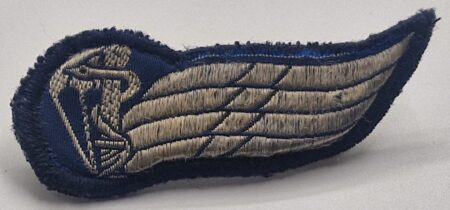
The professions that received the pins are: pilot, combat navigator, air handler, light aircraft pilot, launcher, air gunner and air radio operator, and since 1961 also air mechanic. In the 1970s, single-wing (“half-wing”) fabric pins were designed for air support personnel.
These pins were also inspired by the wing pins of the British Royal Air Force for similar professions. In the 1980s, airborne professions whose training was not part of the flight course (air support crew) received metal pins similar to the wing pins of the United States Air Force.
“Pilot Wings” pin PILOT
https://he.wikipedia.org/wiki/%D7%98%D7%99%D7%99%D7%A1
The good for the pilot and the good for the women too – the story of the Israeli Air Force
https://www.ynet.co.il/environment-science/article/ryeizl1p6
Years of active flight – Silver Wings 25
“Golden Wings” Pilot Pin 50 Years After Completion of Pilot Course
(Full Gold Version)
“Golden Wings” awarded to veteran soldiers
https://www.iaf.org.il/4413-43406-he/IAF.aspx
סיכת “כנפי טיס” של טייס מטוס קל (עד 1974) טייס קישור
https://www.iaf.org.il/9078-51356-he/IAF.aspx
Wings of Shame?
To describe the Piper’s place in the Air Force, one must also return to a story that caused deep frustration for dozens of Piper pilots throughout their years of service in the Air Force. When the pilots completed the flight course, they were considered liaison pilots and were therefore awarded special flight wings with the letter “K” in the center. Instead of the blue Star of David on the wings of today. For the vast majority of pilots, the flight wings did not symbolize a sense of pride in being pilots in the Air Force, but rather a harsh feeling that can be summed up in one word: shame.
“We carried out many dangerous missions behind enemy lines and in Operation Kadesh we even won five medals for special bravery,” says Lt. Col. (res.) Eli Eyal (Feingerash), who was previously the commander of the light squadron. “Despite this, we received humiliating treatment in the Air Force for years.
I turned to Ezer Weizman, the commander of the Air Force at the time, wrote a document and asked to remove this disgrace, the discrimination between wings. After that, a staff discussion was held on the subject.
“At the discussion itself, all the base commanders sat together and in the end a decision was made – no change,” he recalled. “I left the discussion in deep shock. The reasoning for the decision was that training a fighter pilot costs much more than training a liaison pilot. I did not expect to hear that from Weizman.”
For many years, due to a shortage of officer ranks in the light squadron, the Piper pilots were enlisted men, soldiers in every sense of the word. “Have you heard of a pilot who was also a sergeant?” asks Capt. (res.) Moshe Bukai. “I was one of those. Our squadron had ranks for only four officers, so after we finished the pilot course and arrived at the squadron, we were awarded the ranks of ordinary soldiers: sergeant or first sergeant.”
In the early 1970s, Dan Hamitzer was sent to discuss the matter with Benny Peled, who was then the deputy commander of the Air Force. “Feled promised that if he became commander of the Air Force, he would remove the disgrace of the liaison wings,” says Lt. Col. (res.) Eyal. Indeed, in 1975, after Peled was appointed commander of the Air Force, the decision was changed.
The liaison and reconnaissance pilot wings have another aspect: senior officers in the IDF from the ground forces received a chopper and took an accelerated pilot course and received liaison pilot wings, including Chiefs of Staff Haim Barlev and Rafool and Major Generals Zeira Haim Herzog and Yochai Ben Nun (Rapool passed the pilot course in 1952).
If it’s a disgrace in the Air Force, the liaison pilots were called KLOK (Funeral and Burial Officer) and explained that this was the meaning of the “K” on the pilot’s wings. The wings were made of fabric, not metal, but that was their shape.
Fighter navigator and transport navigator wings in the Air Force until 1999. Since 1999, Air Force navigators wear regular pilot wings
, navigator
as in civil aviation is a role that existed in older aircraft (see above), and still exists in large aircraft such as transport aircraft and bombers, Due to the fact that in operational flights it is not always possible to rely on navigational aids, a combat navigator is a second crew member on two-seat combat aircraft. This role evolved from the role of navigators.
In larger aircraft, such as bombers, with the development of advanced navigation systems, the role of the navigator began to change, and he was given responsibility for the aircraft’s armament systems, especially guided weapons systems.
In the United States Air Force, the position is called Weapon Systems Officer, and in the United States Navy, the position is called Radar Intercept Officer. An air navigator (other than a combat navigator) is a second or sometimes third crew member on transport or reconnaissance aircraft. An example of this was in the Israeli Air Force – an air navigator as part of the “Sea-Scan” (“Seagull”) flight crew.
https://he.wikipedia.org/wiki/%D7%A0%D7%95%D7%95%D7%98_%D7%A7%D7%A8%D7%91
Who are you, transport navigator?
https://www.iaf.org.il/4480-50734-he/IAF.aspx
Airman – A crew member on transport aircraft, responsible for operating the various aircraft systems (fuel, electrical, engine, etc.). Performs maintenance, control, and problem analysis. The civilian name for the profession is “flight engineer.”
Flight instructor wings in the Air Force until 1999. Since 1999, Air Force instructors have worn regular flight instructors wings.
https://he.wikipedia.org/wiki/%D7%9E%D7%94%D7%A0%D7%93%D7%A1_%D7%98%D7%99%D7%A1%D7%94
https://www.iaf.org.il/4405-41531-he/IAF.aspx
https://www.iaf.org.il/7203-41811-he/IAF.aspx
https://www.mako.co.il/pzm-units/air-force/Article-37904ce9383f151006.htm
https://www.iaf.org.il/9311-52676-he/IAF.aspx
Air support team in the Flying Fortress
https://www.iaf.org.il/7186-41603-he/IAF.aspx
From the Metin
The Metin wings were awarded to graduates of a flight course within the framework of the NEMA squadron (navigators, gunners/launchers, radio operators). At the end of the course, the trainees received the rank of second lieutenant and flight wings, centered on a drawing of a bomb. From the Metin
He was a crew member in bombers. His job was to locate the target and drop the bombs at the right moment.
With the development of weapons drop systems, the role has changed and today the aircraft pilot or combat navigator is responsible for dropping the weapons.
Mitilen’s “Flight Wings” pin (until 1958)
https://he.wikipedia.org/wiki/%D7%9E%D7%98%D7%99%D7%9C%D7%9F
Air gunner (until 1958)
An air gunner
is a crew member responsible for operating the aircraft’s defensive armament. Gunners were crew members of large aircraft, mainly heavy bombers but also light bombers. The gunners manned the machine guns in the various positions, and were named after their position: tail gunner, nose gunner, etc.
Air gunner wings.
The wings were intended for the crew of the Flying Fortress bombers of the 69th Squadron.
At the end of 1958, the aircraft were retired due to the lack of need for aerial gunnery roles, and the wings were retired.
https://he.wikipedia.org/wiki/%D7%9E%D7%A7%D7%9C%D7%A2%D7%9F_%D7%90%D7%95%D7%95%D7%99%D7%A8
Air radio operator (until 1972)
Air radio operator wings were awarded to graduates of a two-year radio operator course at a flight school, along with the ranks of second lieutenant. An air radio operator or airborne radio operator was a profession for aircrew members. A radio operator was a crew member on bombers and transport aircraft responsible for operating the radios, some of which transmitted Morse code. With the development of advanced communication systems, the position became redundant and was abolished.
https://he.wikipedia.org/wiki/%D7%90%D7%9C%D7%97%D7%95%D7%98%D7%9F_%D7%90%D7%95%D7%95%D7%99%D7%A8
Air Mechanic (1961-1989)
Air Mechanic pin used from 1961-1989. From 1961-1978, the role of the Air Mechanic was defined as an aircrew member, and therefore the pin was designed as full wings rather than a single wing, similar to aircraft wings
An aircrew mechanic
is an aircrew member, mainly in helicopters. His duties include operating the helicopter’s cargo bay
– responsible for the entry and exit of fighters, evacuation and rescue of the wounded, and the like; operating the helicopter’s systems, including the crane and cargo rack, as well as systems in the cockpit; and handling malfunctions during the flight
https://he.wikipedia.org/wiki/%D7%9E%D7%9B%D7%95%D7%A0%D7%90%D7%99_%D7%9E%D7%95%D7%98%D7%A1
Flight controller pin of the 192nd Squadron, during the “Dia” aircraft era (until 1994)
Airborne Controller
Airborne Control Systems Operator Wings
Aviation Controller Cloth Wings Pin in the 192nd Squadron “Hawkeye Squadron” during the “Dia” aircraft era (until 1994).
Description of the emblem: Woven fabric wings, with a shield on top, above which is a blue circle symbolizing the sky from the center of which radar waves emanate.
The emblem was used between 1979-1994
In 1989, as part of a uniform move to replace the wings of the air support crew from cloth wings to metal wings.
https://israel-insignia.com/insignia/7736-2
/
Red Frame Cloth Pilot Wings Emblem
Red Frame Cloth Pilot Wings Cloth Pilot Wings – Red Background
These special wings were awarded to Israeli Air Force pilots between 1949-1950 only.
The red frame indicates that the pilot participated in more than 50 operational flights during the War of Independence.
This is a replica of the mythical wings.
The originals are on display at the Air Force Museum, worn on a flight instructor uniform set
Air Mechanic
(1978 version, not used)
Air Mechanic
A pin with one wing. Designed in 1978 when the status of air mechanics in the Air Force was changed from air crew to air support crew. In practice, the pin was not used, and in the field, soldiers continued to wear the full wings designed in 1961.
Airborne electronic warfare operator ( until 1989 )
https://www.iaf.org.il/4343-28857-HE/IAF.aspx
https://recruits.iaf.co.il/6566-he/IAF.aspx
A loadmaster
is a crew member on transport aircraft. He is responsible for planning the loading of cargo onto the aircraft in the most efficient and optimal way, while maintaining the center of gravity and balance of the aircraft for stable flight.
https://www.iaf.org.il/9073-50925-he/IAF.aspx
https://he.wikipedia.org/wiki/%D7%A4%D7%A7%D7%97_%D7%94%D7%A2%D7%9E%D7%A1%D7%94
Air support staff in the medical system (until 1989)
https://he.wikipedia.org/wiki/%D7%A6%D7%95%D7%95%D7%AA_%D7%A2%D7%96%D7%A8_%D7%90%D7%95%D7%95%D7%99%D7%A8_%D7%91%D7%9E%D7%A2%D7%A8%D7%9A_%D7%94%D7%A8%D7%A4%D7%95%D7%90%D7%94
https://www.iaf.org.il/4968-en/IAF.aspx
https://www.iaf.org.il/618-19846-he/IAF.aspx
https://israel-insignia.com/insignia/7898-2
Airborne Mechanic to date 1989
https://israel-insignia.com/insignia/7807-2
Airborne Electronic Warfare Operator 1989 to Present
Airborne Electronic Warfare Systems Operator
Responsible for operating airborne electronic warfare systems
https://israel-insignia.com/insignia/7790-2
Airborne Electronic Warfare Operator
(1994 version, unused)
https://israel-insignia.com/insignia/7790-2
Loading Inspector (Unit -757) to date 1989
https://israel-insignia.com/insignia/7851-2
Loading Inspector
(1994 version, not used)
https://israel-insignia.com/insignia/7851-2
/
Airborne flight controller (until 2005)
https://israel-insignia.com/insignia/7734-2
Airborne Flight Controller
(1994 version, unused)
https://israel-insignia.com/insignia/7734-2
Airborne Flight Controller
Service in the air force control field means observing vast distances using the most advanced means, seeing in real time what is happening in the air around the country. Airborne controllers are the ones who coordinate between the various air force aircraft in training missions, military operations or strikes that are covered in the media only “according to foreign publications”.
Whoever manages to get the position will find himself in the “Nachshon” aircraft squadron. He will go on detection and warning missions, command and control, interception and classified missions, some outside Israeli territory. Training for the position lasts about six months and one must commit to 32 months of compulsory service – “a woman’s right is a man’s”
Airborne Flight Controller (New)
https://israel-insignia.com/insignia/7731-2
Training to fly high and at low speed: A special visit to the Air Force’s reconnaissance aircraft squadron
https://www.israeldefense.co.il/node/57295
Sky Defenders: Who are you, Airborne Flight Controller?
https://www.iaf.org.il/9072-50881-he/IAF.aspx
Airborne controller
The operator of command and control systems in command and control aircraft
https://israel-insignia.com/insignia/7885-2
Medical Auxiliary Team
Medics, paramedics and airborne doctors who join the aircraft crew on rescue and medical assistance flights
Medical Auxiliary Team
(1994 version, not used)
https://israel-insignia.com/insignia/7885-2
Rescue fighter in Unit 669, metal version (starting in 1989)/
https://israel-insignia.com/insignia/7889-2
Flight Test Engineer
(1994 version, unused)
https://israel-insignia.com/insignia/7867-2
Joint Air Patrol Pin
Responsible for observation using various observation means from reconnaissance aircraft
Air reconnaissance pin in the Israeli Air Force..
(Nickel, 3.5 cm long
https://he.wikipedia.org/wiki/%D7%A1%D7%99%D7%99%D7%A8_%D7%90%D7%95%D7%95%D7%99%D7%A8
https://israel-insignia.com/insignia/7901-2
aval Air Reconnaissance Pin, until 2017, in the Naval Reconnaissance Division (NRD). The unit, in its previous form, was operated jointly by Squadron 120
and the Missile Ship Squadron
, currently Squadron 13 Observation Fighter Pin
https://www.mako.co.il/pzm-units/navy/Article-e815854fdc9e841006.htm
https://beingalim.wordpress.com/wp-content/uploads/2021/01/1978-6-beingalim.pdf
Responsible for observation using various observation means from reconnaissance aircraft
https://www.iaf.org.il/1821-26725-he/IAF.aspx
Airborne Weapon Systems Operator
https://israel-insignia.com/insignia/7875-2
https://www.globes.co.il/news/article.aspx?did=1000069328
Airborne Communications Operator
When the aircraft is used as a radio relay responsible for operating radio communications systems
Airborne Communications Operator
(1994 version, not used)
https://israel-insignia.com/insignia/%d7%9b%d7%a0%d7%a4%d7%99-%d7%9e%d7%a4%d7%a2%d7%99%d7%9c-%d7%9e%d7%a2%d7%a8%d7%9b%d7%95%d7%aa-%d7%a7%d7%a9%d7%a8-%d7%9e%d7%95%d7%98%d7%a1
A 3.5 cm long pin designated for use in 1994. The pin is not in actual use and has not been awarded in wing orders.
https://israel-insignia.com/insignia/7807-2
/
A 7 cm long pin that is currently in use, as of 2021, and is awarded at wing orders of airborne mechanics held at Palmachim Base.
https://israel-insignia.com/insignia/7807-2
https://he.wikipedia.org/wiki/%D7%9E%D7%9B%D7%95%D7%A0%D7%90%D7%99_%D7%9E%D7%95%D7%98%D7%
https://www.iaf.org.il/1779-26840-he/IAF.aspx
Israel Police Pilot Wings
Blue Skies: Police Pilot Wings – Israel Police Heritage Center
Sky Police
https://www.policemuseum.org.il/he/police_squadron
https://www.iaf.org.il/2108-28041-he/IAF.aspx
Israel Police Air Unit
https://he.wikipedia.org/wiki/%D7%94%D7%99%D7%97%D7%99%D7%93%D7%94_%D7%94%D7%90%D7%95%D7%95%D7%99%D7%A8%D7%99%D7%AA_%D7%A9%D7%9C_%D7%9E%D7%A9%D7%98%D7%A8%D7%AA_%D7%99%D7%A9%D7%A8%D7%90%D7%9C
Police pilot wing emblem.
Due to the scarcity of police pilots in the 1950s-1960s, standard police wings were not produced and the emblem was actually improvised from the wings of a military pilot and the addition of a button from a winter uniform (which was in use at the time) with the police emblem embossed on it.
Rare find: Pilot’s wings from the secret Irgun course
https://www.israelhayom.co.il/military-life/article/11556693
Airborne Fire and Rescue Officer Wings
Aerial Firefighting Unit
https://he.wikipedia.org/wiki/%D7%99%D7%97%D7%99%D7%93%D7%AA_%D7%94%D7%9B%D7%99%D7%91%D7%95%D7%99_%D7%94%D7%90%D7%95%D7%95%D7%99%D7%A8%D7%99
Air Medical Evacuation Team Wings
Aviation Cast
https://he.wikipedia.org/wiki/%D7%9C%D7%94%D7%A7_%D7%AA%D7%A2%D7%95%D7%A4%D7%94