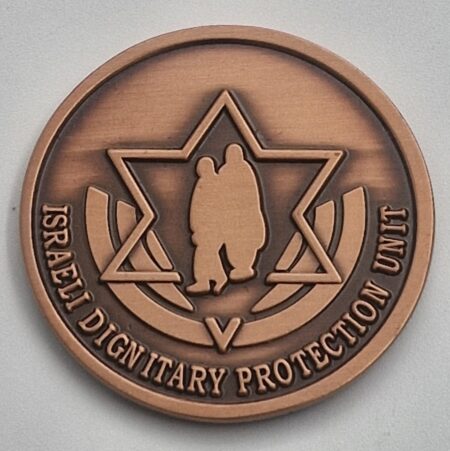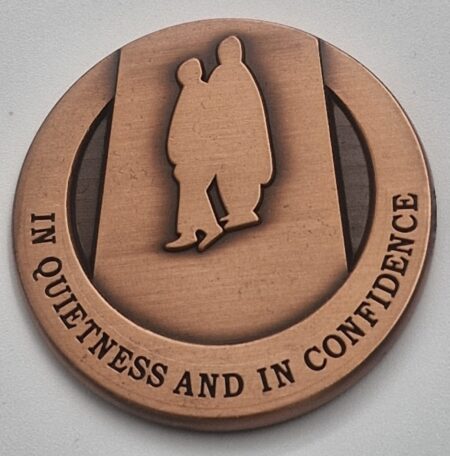

Showing the single result
Medal
https://he.wikipedia.org/wiki/%D7%9E%D7%93%D7%9C%D7%99%D7%94
Medals and Coins
https://dinamic.co.il/%D7%A2%D7%9C-%D7%9E%D7%98%D7%91%D7%A2%D7%95%D7%AA-%D7%95%D7%9E%D7%93%D7%9C%D7%99%D7%95%D7%AA/
A challenge coin is a small coin or medallion, bearing the emblem or symbol of an organization and worn by members of the organization. Traditionally, they may be given to prove membership when requested and to boost morale. They are also collected by service members and law enforcement personnel.
They are also collected by service members and law enforcement personnel. Historically, challenge coins were presented by unit commanders in recognition of a special achievement by a member of the unit. They can also be given as a token of appreciation during visits to the organization.
Challenge coins are produced in a variety of sizes
There are several stories detailing the origins of the tribute coin. Many originate from popular culture based on current events.
The Roman Empire rewarded soldiers by presenting them with coins to recognize their achievements.
Honorary coins were also known as “portrait medals” during the Renaissance.,
The first instance of the use of currency in response to a real challenge may come from the 17th-century Wars of Religion in France. Following the revocation of the Edict of Nantes by King Louis XIV in 1685, French Protestants began to suffer persecution by the state for their illegal religion.
. Many Protestants fled France to find religious freedom elsewhere. Among those who chose to remain in France were some from a Protestant group known as the Huguenots who were forced to conduct their religious services in secret.
In order to avoid infiltration by state spies, the Huguenots began to carry their own holy coin. When challenged while trying to gain entry to Protestant church services, the Huguenot would produce his coin as a token to show loyalty to the Protestant church and be admitted.
According to one story, challenge coins originated during World War I. Before the United States entered the war in 1917, American volunteers from all over the country filled the new flying squadrons of the Army and Naval Air Service. Some were wealthy cadets from colleges like Yale and Harvard who left mid-term to join the war effort.
In one squadron, a wealthy lieutenant ordered solid bronze medallions to be cast and presented to his unit. One young pilot placed the medallion in a small leather pouch that he wore around his neck. Shortly after purchasing the medallion, the pilot’s plane was badly damaged by ground fire. He was forced to land behind enemy lines and was immediately captured by a German reconnaissance.
. In order to discourage his escape, the Germans took all his personal identification except for the small leather pouch around his neck. In the meantime, he was taken to a small French town near the front. Taking advantage of the bombing that night, he escaped. However, he was without personal identification. He managed to evade German patrols by dressing in civilian clothes and reached the front lines.
. With great difficulty he crossed the no man’s land. Eventually, he came across a French post. Saboteurs were patrolling the French in the sector. Sometimes they disguised themselves as civilians and wore civilian clothes. When the French did not recognize the young pilot’s American accent, they thought he was a saboteur and prepared to execute him
He had no ID to prove his loyalty, but he had his leather case containing the medallion. He showed the medallion to his executioner and one of the French captors recognized the squadron insignia on the medallion. They delayed his execution long enough for him to confirm his identity. Instead of shooting him, they gave him a bottle of wine.
Back in his squadron, it became a tradition to ensure that all members carried their medallion or coin at all times. This was achieved through a challenge as follows: a challenger would ask to see the medallion, if the challenger failed to produce a medallion, they were required to buy a drink of their choice for the member who challenged them.
If the challenged member produced a medallion, then the challenging member was required to pay for the drink. This tradition continued throughout the war and for many years after the war while the surviving members of the squadron were still alive.
According to another story, challenge coins date back to World War II and were first used by Office of Strategic Services personnel deployed in Nazi-held France. During a personal meeting to help verify a person’s identity. There will be specific aspects such as the type of coin
, date of coin, etc. checked by each party. This helped prevent infiltration of the meeting by a spy who would have to have prior knowledge of the time and place of the meeting as well as what coin was to be presented, among other things, in good faith.
Others claim the tradition began during the Vietnam War, when a bar run by the Army Infantry tried to keep non-infantry soldiers away by forcing “outsiders” to buy drinks for the entire bar if they couldn’t prove they had been in combat. The “proof” started with enemy bullets, then got a little out of hand with grenades,
Rockets and unexploded ordnance. Therefore, a coin-sized item with the unit’s symbol became the accepted form of proof. This tradition, now known as a coin check, continues today, hence the name “challenge” coin.
While several legends place the emergence of challenge coins in the post-Korean Conflict era (some as late as the Vietnam War), or even later, Colonel William “Buffalo Bill” Quinn made coins for those who served in his 17th Infantry Regiment during 1950 to 1958. The 17th Infantry Regiment “Buffalo” coin is the oldest known challenge coin in existence. . On one side of the coin was an image of a buffalo with the date 1812, marking the year the unit was founded. On the other side was the 17th Infantry patch with the dates 1950 – 1958 and the word Korea for the patrol mark. The cross and emblem represent the unit’s heritage which began in Cuba during the Civil War. This coin is recognized as one of the oldest and most valuable challenge coins in circulation. Very few remain available, and most are considered private collections.
Colonel Vern Green, commander of the 10th Special Forces Group-A, embraced the idea. A special coin was minted with the unit’s badge and motto in 1969. Until the 1980s, his unit was the only one with an active challenge coin tradition.
There is another story about an American soldier who was supposed to meet with Filipino guerrillas during World War II. As the story goes, he carried a Philippine silver coin stamped on one side with the unit’s insignia. The coin was used to assure the guerrillas that the soldier was their valid contact for the mission against the Japanese.
The tradition of challenge coins has spread to other military units, across all branches of service, and even to non-military organizations, as well as the United States Congress, which produces commemorative coins for members of Congress to give to voters. Today, commemorative coins are given to members upon joining an organization, as a reward for improving morale.
, and are sold to commemorate special events or as a fundraiser. In the Air Force, military training instructors award a pilot’s coin to new enlisted personnel upon completion of United States Air Force Basic Military Training and to new officers upon completion of Air Force Officer Training School.